For most of the twentieth century, computing progress was a story told in transistors — ever-smaller, ever-faster silicon switches that doubled in density with quiet, clockwork reliability. That story, elegant as it was, has reached the limits of physics. The gates are so thin that electrons tunnel through them like ghosts through walls. Heat accumulates. Interference multiplies. The classical regime, which carried humanity from vacuum tubes to smartphones, is running out of runway. But in a series of climate-controlled laboratories stretching from Tokyo to Chicago, Zurich to Shanghai, a genuinely new chapter is being written — one in which quantum mechanics is not an obstacle to be engineered around, but the very engine of computation.
What Quantum Computing Actually Means
The word "quantum" has been colonised by marketing departments to mean little more than "very advanced," but the physics is precise and strange. Classical computers encode information in bits — discrete states of zero or one. Quantum computers use qubits, which exploit superposition to exist in a combination of zero and one simultaneously. When you entangle multiple qubits, their states become correlated in ways that have no classical analogue. Measuring one qubit instantaneously determines the state of its entangled partner, regardless of distance.
This sounds like sleight-of-hand, but it translates into an explosive parallelism. A fifty-qubit processor can, in principle, represent 2⁵⁰ states simultaneously — roughly a quadrillion values at once. For certain classes of problems — factoring enormous numbers, simulating molecular chemistry, optimising logistics networks with millions of variables — this is not an incremental improvement. It is a qualitative leap.
"We are no longer asking whether quantum computers will be useful. We are asking how quickly we can make them reliable enough to deploy at scale."
— Dr. Keiko Hara, Director, RIKEN Center for Quantum Computing, WakoThe Neural Fusion: When Quantum Meets AI
The intersection that is generating the most excitement — and the most venture capital — is Quantum AI: the application of quantum computing to machine learning and neural network training. The intuition is straightforward. Training a large language model today requires weeks of computation across tens of thousands of GPUs. Energy consumption is measured in megawatt-hours. The carbon footprint is substantial. Quantum algorithms, once sufficiently error-corrected, could perform the matrix multiplications at the heart of deep learning with dramatically fewer operations.
IBM's Quantum Heron processor, unveiled in late 2025, demonstrated a 4,000-qubit architecture with error rates below 0.1% — the first time any commercial system crossed what researchers call the "fault-tolerant threshold." Google's Willow-II, operating at Google X's Santa Barbara facility, has extended coherence times to 1.8 milliseconds, a figure that seemed fantastical as recently as 2022. At Japan's RIKEN institute, a hybrid classical-quantum system completed a protein-folding calculation in eleven hours that had previously required three weeks on a 512-GPU cluster.
In February 2026, a joint team from MIT and Toshiba's quantum division demonstrated the first quantum-trained transformer model, achieving equivalent accuracy to a classical GPT-4-scale model using 40% less energy and 60% less training time on a 1,200-qubit testbed.
The Error Correction Problem
Despite these milestones, the central technical challenge of quantum computing remains unsolved at practical scale: error correction. Qubits are extraordinarily fragile. Stray electromagnetic fields, temperature fluctuations of a fraction of a degree, even cosmic rays can flip a qubit's state — an event called decoherence. Classical computers handle bit errors with straightforward redundancy; quantum mechanics makes direct copying impossible (the no-cloning theorem forbids it), demanding far more elaborate strategies.
The leading approach is topological error correction, in which logical qubits are encoded across many physical qubits in entangled arrays. Microsoft's Station Q, collaborating with Copenhagen's Niels Bohr Institute, published results in March 2026 showing a logical error rate of 10⁻⁶ using a surface-code array of 200 physical qubits per logical qubit. That overhead is steep — a million-qubit machine to support 5,000 logical qubits — but the roadmap is credible for the first time.
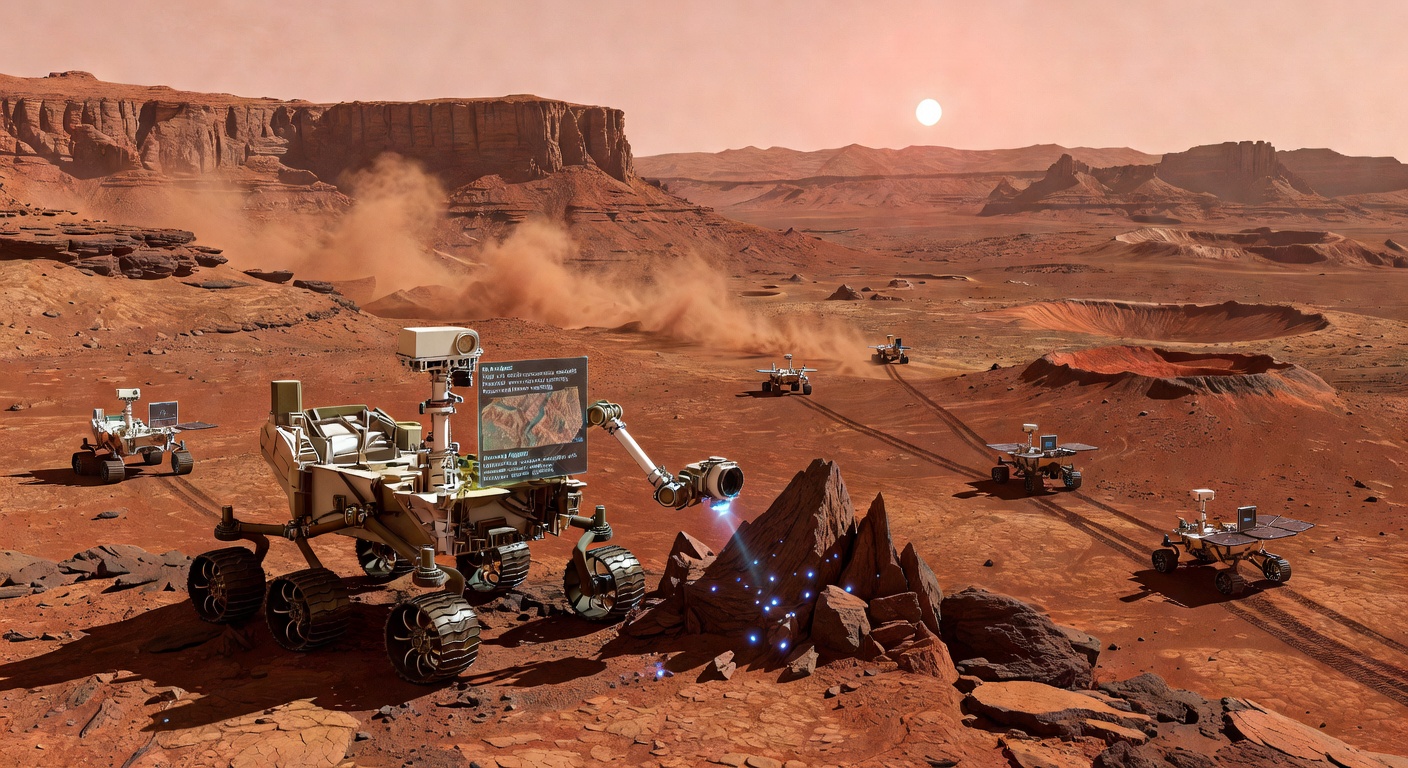
Quantum AI research increasingly intersects with fields once thought remote — from astrophysics to materials science. Image: Nextgenai Research Lab
Industry Applications Already Emerging
Even before full fault tolerance arrives, so-called Noisy Intermediate-Scale Quantum (NISQ) devices are finding commercial traction. Pharmaceutical companies including Pfizer, Merck, and Japan's Chugai are running quantum chemistry simulations to model how candidate drug molecules interact with target proteins — a calculation that is intractable classically for systems of more than a hundred atoms. Early results have yielded three compounds advanced to human trials that would not have been identified through conventional computational screening.
In finance, JPMorgan Chase's quantum research team has demonstrated portfolio-optimisation algorithms on IBM hardware that outperform classical heuristics for asset universes exceeding 10,000 instruments. The bank estimates that production-quality quantum optimisation could reduce hedging costs by 12% annually — a figure in the hundreds of millions of dollars. Toyota's logistics division, working with Fujitsu's quantum-inspired annealing processors, has cut supply-chain optimisation compute time from six hours to nineteen minutes.
"Quantum advantage for AI training is not a question of if — the mathematics is settled. It is entirely a question of engineering timelines, and those timelines have compressed by a decade in the last three years."
— Prof. Arjun Mehta, Quantum Machine Learning Laboratory, IIT BombayWho Leads the Quantum Race?
The geopolitics of quantum computing has become as charged as that of semiconductors. The United States maintains a structural lead in qubit quality and algorithm research, bolstered by DARPA's $3.7 billion Quantum Advantage initiative and massive private investment from Google, IBM, Microsoft, and a constellation of startups. China's National Laboratory for Quantum Information Sciences in Hefei has announced a 10,000-qubit photonic chip scheduled for demonstration before the end of 2026, though independent verification of Chinese quantum claims has historically proven difficult.
Europe has channeled €2.4 billion through the EU Quantum Flagship programme, producing strong results in communication (quantum key distribution networks now span the continent) and sensing, while lagging in large-scale processors. Japan's "Quantum Innovation Strategy 2030" is producing arguably the world's most sophisticated error-correction research, with RIKEN and NTT jointly developing photon-based qubits that operate at room temperature — a breakthrough that, if sustained, would eliminate the need for dilution refrigerators running near absolute zero and transform the economics of the entire industry.
What Comes Next
The consensus among researchers — carefully avoiding the hype cycles that have scarred the quantum field before — is that we are entering a transitional decade. Between 2026 and 2030, quantum advantage will be demonstrated for an expanding range of practical problems: drug discovery, materials science, cryptography, climate modelling, and eventually AI training at scale. Full fault-tolerant quantum computing, capable of running arbitrary algorithms with the reliability of classical hardware, is most credibly projected for the early 2030s.
For artificial intelligence, the implications are staggering in scope. Current large language models are constrained by the energy and compute cost of training. A world in which quantum processors dramatically reduce that cost is a world in which AI capabilities advance faster, spread more broadly, and become accessible to organisations that cannot today afford the infrastructure. Whether that acceleration is channelled toward human flourishing — accelerating medicine, climate solutions, scientific discovery — or amplifies existing inequalities and risks will depend not on the physics, but on the choices of the people building and governing these systems.
In the quiet hum of dilution refrigerators, in the flickering coherence of entangled qubits, the outlines of a new computational order are forming. The neural revolution and the quantum revolution are converging, and the resulting transformation may dwarf everything that came before.